Theory
Purple Arcanum
Star typePurple Arcanum – Star type
In the Purple Arcanum systems currently in circulation, the number of stars used within a natal chart has exceeded one hundred. This scale is largely the result of different schools, over extended periods of development, gradually incorporating their preferred observational experiences and perceived temporal patterns into a shared structural framework. However, an increase in the number of stars does not necessarily correspond to an improvement in informational quality. In practice, not all stars possess the same level of clarity or stability in their informational density.
By comparison, the number of stars that demonstrate high recognizability and consistent directional meaning, while not reverting to the eighteen core stars favored by early schools, is still significantly smaller than the total number formally included in the contemporary system.
Most stars in Purple Arcanum are symbolic constructs derived from specific temporal patterns. Some stars are generated in relation to monthly cycles, while others correspond to calendar dates or birth hours. Unlike Western astrology or Indian astrology, which rely on a relatively small number of celestial bodies to form an integrated framework, Purple Arcanum exhibits a more fragmented and hierarchical system structure. The rules governing natal chart configurations and star placements were largely compiled during the late Qing dynasty in classical Chinese. Later generations collectively referred to these texts that systematized star-placement methods as 「安星訣」.

Across different schools of Purple Arcanum, interpretations of certain stars have long remained inconsistent. These differences are not limited to the prioritization of informational significance but often extend to divergent understandings of the meanings attributed to the stars themselves. As such interpretations are primarily derived from the experiential accumulation of astrologers across generations, and lack correspondence with modern academic models, they remain fundamentally within the domain of subjective inference.
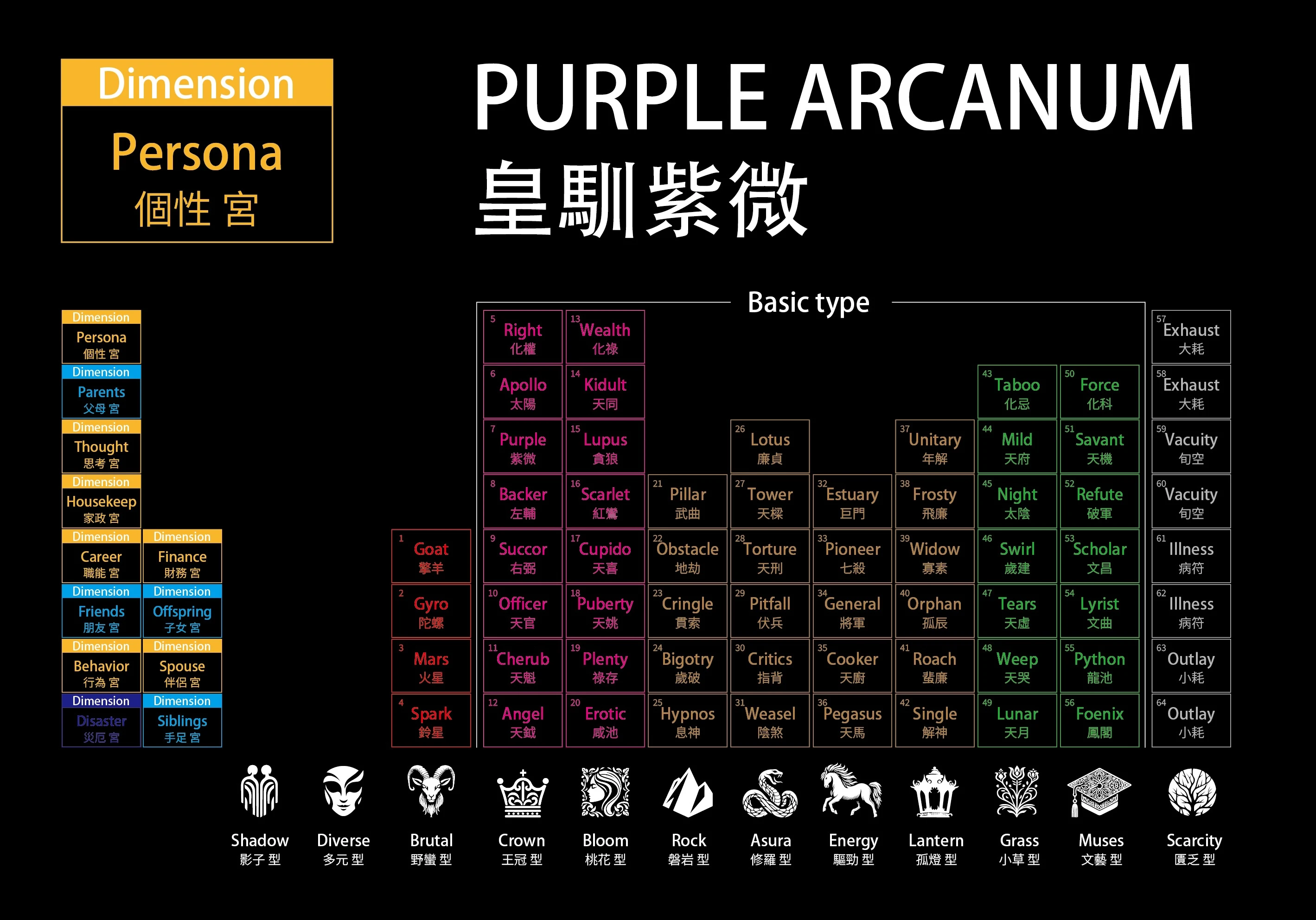
Through long-term empirical examination, our system has progressively compared and organized a large number of natal chart cases, ultimately identifying sixty-four stars within Purple Arcanum that consistently exhibit relatively direct and stable informational indications across most dimensions. Based on this finding, the system further incorporates contemporary psychological frameworks of personality trait classification as its primary reference for reorganizing and categorizing these stars. After structural refinement, these sixty-four stars are consolidated into ten distinct types, transforming originally fragmented and inconsistently interpreted star information into a more coherent and comprehensible analytical structure.
These ten star types undergo varying degrees of definitional adjustment across different dimensions according to their functional attributes. However, not every dimension is capable of fully expressing the distinctions among all ten types. Taking the behavior dimension as an example, only three star types provide relatively clear and consistent informational indications, corresponding respectively to behavioral tendencies such as diligence, laziness, and revenge. The remaining seven types, within this dimension, lack stable and reproducible interpretive significance.
Dimensions that are capable of simultaneously expressing the full range of differences among the ten types are typically concentrated in areas related to personality structure and interpersonal interaction. This distribution pattern may also be understood as a historical outcome of the long-term influence of Confucian thought on Chinese social values and behavioral norms, wherein observations of character and relational dynamics were accorded relatively higher importance within traditional culture. By contrast, certain dimensions such as the CAREER dimension and the FINANCE dimension reflect a substantial mismatch between the historical context in which Purple Arcanum was formed and the occupational structures and economic systems of modern society. As a result, analytical conclusions drawn from these dimensions cannot be expected to fully correspond to contemporary conditions. The information provided by such dimensions should therefore be regarded as directional reference only, rather than as a basis for concrete decision-making.

In practical natal chart analysis, any single dimension may simultaneously present information from more than two types. When multiple types coexist, their significance is not necessarily equal. Generally speaking, types that manifest in more extreme or more self-centered forms tend to exert greater dominance. This is not a value judgment, but rather an observation grounded in the structure of human nature: tendencies toward self-preservation and self-interest have consistently constituted the most fundamental and stable core of human personality.
Based on the long-term organization and verification of sixty-four stars, this system consolidates them into the following ten primary types, which are used to describe psychological and behavioral tendencies across different layers of the natal chart:
Star Type
Crown type includes eight stars: Rule, Apollo, Purple, Backer, Succor, Officer, Cherub, and Angel.
Bloom type includes eight stars: Wealth, Kidult, Lupus, Scarlet, Cupido, Puberty, Plenty, and Erotic.
Rock type includes five stars: Pillar, Obstacle, Cringle, Bigotry, and Hypnos.
Asura type includes six stars: Lotus, Tower, Torture, Pitfall, Critics, and Weasel.
Energy type includes five stars: Estuary, Pioneer, General, Cooker, and Pegasus.
Lantern type includes six stars: Unitary, Frosty, Widow, Orphan, Roach, and Single.
Grass type includes seven stars: Taboo, Mild, Night, Swirl, Tears, Weep, and Lunar.
Muses type includes seven stars: Force, Savant, Refute, Scholar, Lyrist, Python, and Foenix.
Brutal type includes four stars: Goat, Gyro, Mars, and Spark.
Scarcity type includes eight stars: Exhaust, Exhaust, Vacuity, Vacuity, Illness, Illness, Outlay, and Outlay.